






Free written scope consultation - allowances, timeline, and change-order rules on paper before a single trade is scheduled
Tamko Fence Installation: The Fort Worth Owner’s Guide
Tamko fence installation in Fort Worth typically runs $3,500 to $9,000 for a complete project, depending on linear footage, gate count, and whether the existing posts can be reused. We stock Tamko-compatible materials and can match the exact profile and color on most lines, so you’re not mixing a new section into an older fence that won’t look right. Most Fort Worth homeowners discover their fence has failed the hard way: a section leaning after a spring storm, a gate dragging in the mud, or a post that snapped at ground level where the Texas clay held water against it for years.
What we see most often on Tamko fences in Fort Worth isn’t a product defect. It’s the ground and the weather doing what the ground and weather do here. Clay soil that swells in spring and cracks in August, a wind gust off the open prairie west of town, a sprinkler head that’s been spraying the same post for six summers straight. The fence gives out at the weakest point, and that point is almost always where the post meets the soil, or where a gate pulls against its hinges year after year.
Which Tamko Models This Applies To

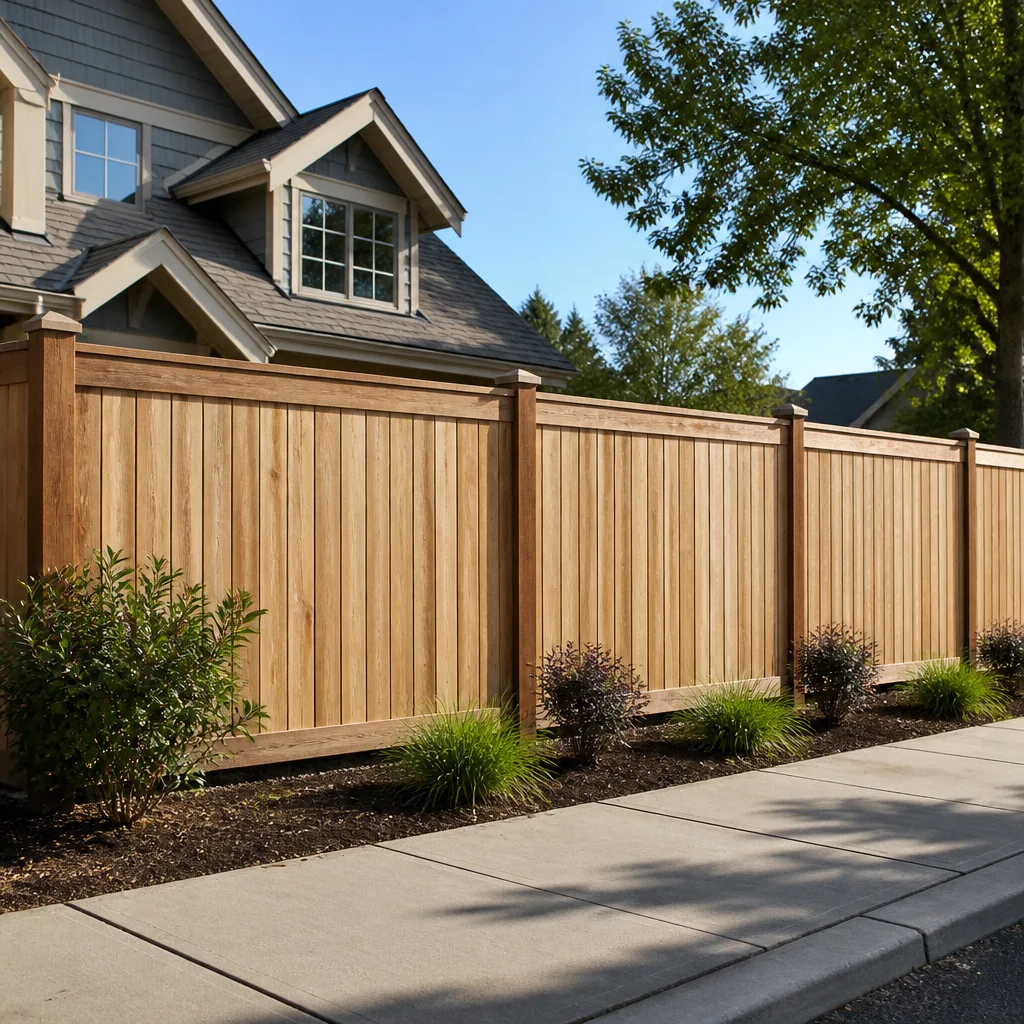
We work on the full range of Tamko fencing products common in Fort Worth homes: privacy fence panels in the 6-foot standard, shadowbox and board-on-board patterns, and their vinyl and composite lines where those were installed. The key to matching a repair or new run is identifying the exact profile. Tamko’s board-on-board privacy panel has a distinct overlap depth that’s slightly deeper than most off-the-shelf panels from big-box stores. If you hold a tape measure to the face board, the reveal on Tamko panels typically measures around 6 to 6-1/4 inches on their most common Fort Worth-installed models. That’s the number to match.
For the OEM-versus-aftermarket decision: for load-bearing components like posts and rails, we source directly from Tamko-authorized distributors where the product line is still produced. For pickets and trim boards, a quality cedar or treated pine aftermarket equivalent matched to the original dimensions holds up just as well. The honest reality is that some older Tamko lines have shifted production specs over the years, so a panel you bought in 2016 may not match a 2026 panel from the same nominal series. We measure what’s on your fence, not what the box says, and we’ll tell you before we order anything whether an exact match is possible or whether a section replacement is the better route.
Styles & brands we work with



Signs Your Tamko Fence Installation Is Failing
- A post leaning more than 5 degrees but still solid at the top. This is almost always a failed footing in Fort Worth’s expansive clay, not a broken post. The soil has moved, the concrete collar has lifted or cracked, and the post is now a lever waiting for a wind event.
- Gate drags on the ground or won’t latch cleanly. The hinge side post has shifted, or the gate frame has absorbed moisture and twisted. Forcing the latch every day will eventually spring the gate frame itself.
- Rails pulling out of the post pockets. The fasteners or the post pocket have rotted or split where the rail seats. This is the classic North Texas pattern: water pools in the pocket, sits against the end grain, and rot follows within a few seasons.
- Pickets cupping, splitting, or pulling free at the nail line. The wood is cycling through wet-dry-wet too aggressively. Once you see more than a third of the pickets on a panel cupped, the panel is nearing the end of its service life.
- A section that sways when you push it by hand. If the whole panel moves as a unit, the rail-to-post connection has failed on at least one end. That’s not a board problem; that’s a structural connection problem that will grow worse with every big wind.
Replacement Cost & What’s Included

A full Tamko fence installation in Fort Worth on a standard city lot, roughly 150 to 200 linear feet with one or two gates, runs $3,500 to $9,000 installed. The range is driven by three things: how much of the existing post line can be salvaged, how many gates are involved, and whether the run follows level grade or a slope. Sloped runs mean stepping the panels or racking them, and that labor shows up honestly on the invoice.
Every scope of work we write for a fence includes the line-item material cost, the per-foot labor, gate hardware as a separate line, and haul-off of the old fence. We don’t bundle debris removal into “labor” as a surprise. Shoe covers and drop cloths are on the truck for any work that runs near the house, and the clean-up photo before the crew leaves is standard, not optional. Our work carries the 365-Day Done Right Promise. If something isn’t right after the job is complete, we make it right. Graham Stein writes every scope of work down before a single tool comes off the truck, and the written price and the final invoice should read the same – if they don’t, that’s on us to explain before we hand you a pen.
See the difference
 Before
 After
 Before
 After
 Before
 After
DIY or Call Us?
For an afternoon’s inspection, there are things a Fort Worth homeowner can check safely: walk the line and note which posts are soft at the base, see which gate is pulling, and look for sprinkler heads spraying the fence. Understanding what’s wrong costs nothing and makes you a better buyer.
Where DIY goes wrong on Tamko fences is in the post pull. A rotted post in clay soil is often encased in a concrete collar that weighs 300 pounds and won’t come out with a pickup and a chain. You’ll tear up the yard, damage the adjacent panels, and still need the right equipment and a second set of hands. Gate adjustment is another one we see overcorrected: a homeowner cranks the turnbuckle or re-hangs the gate on a post that’s the real problem, and now the gate frame is sprung. If you’re anywhere near a gas line easement or the fence line holds a utility right-of-way, that’s a call-before-you-dig situation, and it’s a required call, not a suggestion. Call (682) 708-9180 and we’ll walk the line with you and price it plainly.
FAQs

A treated pine Tamko fence on concrete footings in Fort Worth’s clay soil typically lasts 15 to 20 years with good drainage at the post bases, while cedar versions often run 12 to 18 years depending on sun exposure and sprinkler placement. Posts fail before panels almost every time, which is why we focus drainage and footing detail at every post rather than just setting them in a bag of quick-set.
Yes, when the failure is isolated to one post, one gate, or one panel run. When you have multiple posts soft at the base and more than a third of the pickets cupped or split, you’re in replacement territory. We’ll give you an honest recommendation either way before any work starts, and that recommendation is always written down.
Most standard Fort Worth residential fence projects, 150 to 200 linear feet with a gate or two, take two to three working days from first post hole to final clean-up. Weather and soil conditions can shift that, and we’ll tell you the day before if the schedule is moving.
We stock or can have on hand within a couple of days the common Tamko panel profiles, rail, and hardware used in Fort Worth installations. If your panel line has been discontinued or the spec changed, we’ll match it as close as physically possible and show you the difference before we order. We are an independent service provider, not affiliated with Tamko, but we source their materials through authorized distributors whenever the line is available.
Get Your Fort Worth Fence Priced by Graham Stein
Call (682) 708-9180 for a free estimate on your Tamko fence installation or repair. We answer the phone with a live person, not a voicemail box. We’ll walk your fence line, write the scope of work down, and hand you a written price before any work is scheduled. You’ll know what the fence will cost, what materials are going in, and what the yard will look like when the crew leaves. One call, straight answers, done right.
Written by Graham Stein, Owner, Elmstead Remodeling Fort Worth at Elmstead Remodeling Fort Worth, serving Fort Worth and nearby areas.